
This portfolio holds concepts, prototypes, and systems shaped by lived bedside experience and refined through intentional UI and UX designs. Made to support nurses in the background so they can lead in the foreground.
Welcome.


GET TO KNOW THE DESIGNER.
BUILT FROM BEDSIDE EXPERIENCE.
I am a registered nurse with a Master's degree in Nursing Service Administration who have always been drawn to design and system thinking. I designed the UI/UX, built interactive prototypes, and mapped clinical workflows from the ground up to ensure software reflects real bedside practice.
As these ideas evolved, I have engaged with backend developers to ensure every feature is technically sound, scalable, and feasible. Working with backend developers on the more technical aspects has allowed my ideas to move beyond concepts into tools that will truly work in real healthcare environments.
Last Year, I started designing and working on two major clinician-led healthcare software projects.
CODE BLUE HERO
BEDSIDE FLOW: CHARGE NURSE HERO
Both are grounded in the same Core Philosophy.
Clean. Safe. Precise. Decision Supportive.
Code Blue Hero
was born out of countless
conversations with nurses, clinicians and even
newly trained intensivist who shared a
common struggle.
Running a code is intimidating.
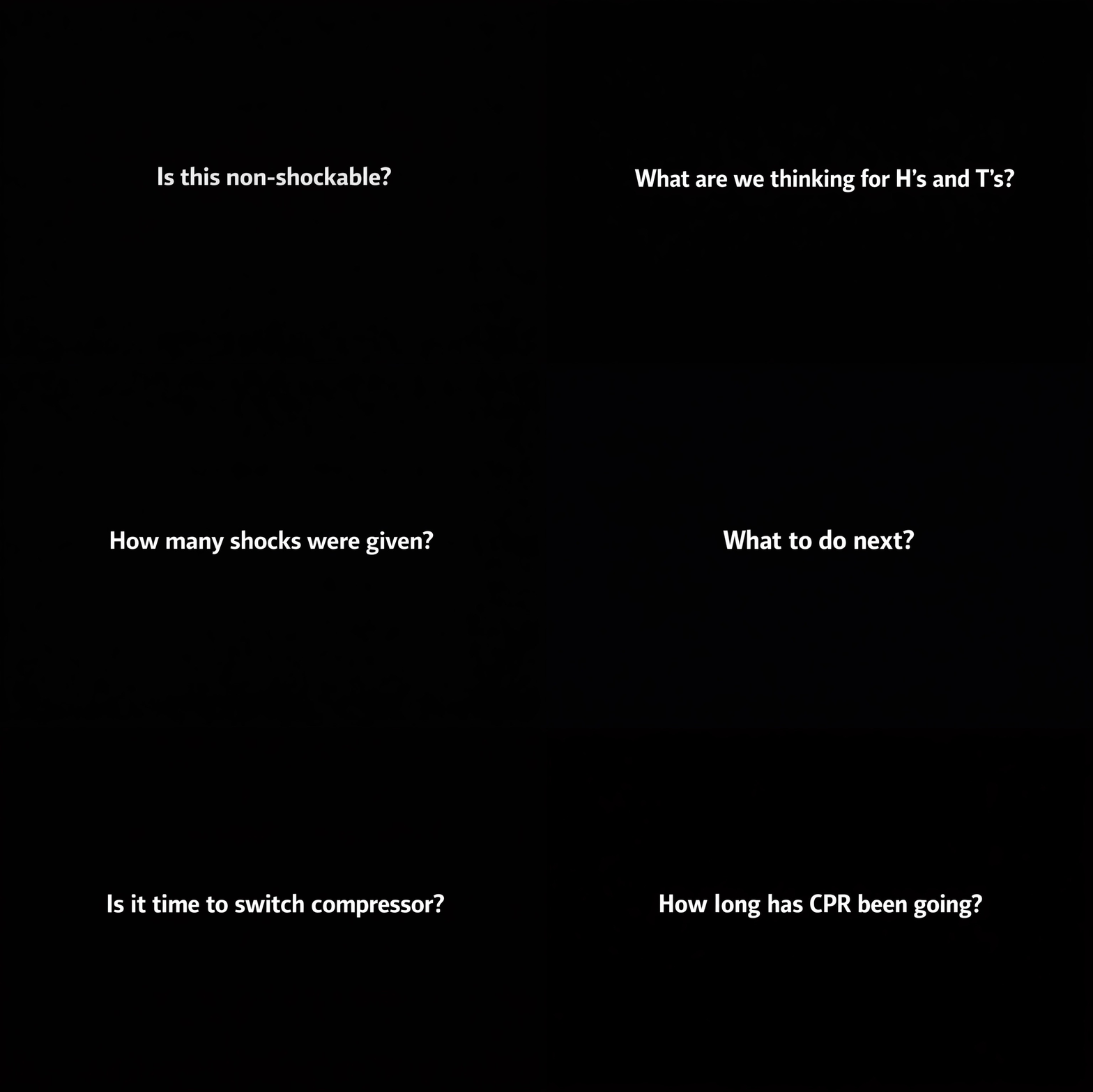
Not because they lack knowledge or skill , but because
of the intense cognitive overload that happens in seconds. Multiple decisions. Competing Priorities. Documentation.
All unfolding within one or two critical minutes.
Despite the stakes, we go into these moments with
no real - time cognitive support tools.

Unlike static ACLS apps or reference cards, Code Blue Hero runs the code with the team. Timers are adaptive and only trigger when action is clinically required. The system guides next best actions in real time, synchronizes the entire team on one shared screen, and automatically logs events. It mirrors AHA algorithms while removing cognitive overload during high-stress moments.
By offloading time tracking, prompts and event capture, clinicians stay focused on patient care, not clocks or memory.
CODE BLUE HERO
Charge nurses are the single most influential operational lever on a unit. Charge nurses make hundreds of micro-decisions each shift and throughout, and yet they are largely unsupported by real-time tools.
More than just digitization: while the platform removes manual assignment sheets and paper huddles, its real value is not efficiency alone.
WHAT MAKES IT DIFFERENT
The platform gives charge nurses the ability to activate and broadcast real time assist when a nurse is drowning. The platform pairs visible leaderboards with a point - based system that tracks when team members step in to help during team assists.
Incentivize helping a fellow nurse.
The idea is to optimize the team when you can't increase the head count of the team due to staffing challenges.
CHARGE NURSE HERO


Future Iteration will leverage AI to transform POST CODE data into meaningful insights.


CHARTING NEW WAYS
IN THE WAY WE RUN CODE BLUE
100%
FOLLOWING ACLS PROTOCOL
APPLE APP STORE SUBMISSION TARGETED BY THE END OF THE MONTH FOR INDEPENDENT DEPLOYMENT
CURRENT PROGRESS
BACKEND LOGIC AND INFRASTRACTURE UNDERGOING FINAL POLISHING
PATENT PENDING
BEDSIDE FLOW:
CHARGE NURSE HERO
PROJECT VISION AND RATIONALE
is built on the belief that nurses deserve their own operational software.
This software is meant to grow and evolve alongside the realities of nursing work, shaped directly by frontline experience.


At a functional level, the software allows charge nurses to create staff assignments and print them easily.
It consolidates the many forms required throughout a shift into a single searchable hub so nurses can quickly find and print what they need.
These are outputs from a mock software prototype I've been working on.
Currently, Nurses are opening Excel, Word or Pen and Paper.


While eliminating pen and paper workflows is valuable, that is not where the true impact of this system lies.
THE REAL VALUE OF BEDSIDE FLOW : CHARGE NURSE HERO
is its deliberate focus on addressing bedside burnout.
From my own experience, burnout is often misunderstood. When a shift is difficult, there is an unspoken expectation that nurses will rely on heroics, too often, whether support arrives depends on the goodwill and personality of charge nurses, nurse managers, and teammates, an informal teamwork to survive the day, rather than a reliable system.
Help is assumed rather than structured.
Bedside Flow asks a different question.
What if we give support structure instead of relying on heroics ?
CREATIVE ANGLES AND VISION
TRANSPARENCY, TEAM ASSIST, HEAT MAP
(Please click on the images for Rationale)


